
When choosing an industrial conveyor supplier, buyers need to consider more than equipment prices. Product availability, technical compatibility, customization options, manufacturing capabilities, and after-sales support are also important factors.
山东东龙传动设备有限公司. specializes in industrial conveying equipment and related components. The company serves a variety of industrial applications, including food and beverage processing, logistics, warehousing, packaging, and manufacturing.
This article introduces Donglong’s business scope, main product categories, application areas, and key considerations when selecting conveying equipment.
1. About Shandong Donglong Transmission Equipment Co., Ltd.
Founded in 2010, Shandong Donglong Transmission Equipment Co., Ltd. focuses on industrial conveying equipment, automation equipment, and production line solutions.
Its product range includes conveying equipment and related components designed to support material transportation, product transfer, and connections between different production processes.
For buyers searching for Donglong conveyor equipment, conveyor belts, or customized conveyor lines, understanding the available products and technical requirements is an important first step.
Visit the Donglong About Us page to learn more about the company.
2. What Products Does Donglong Offer?
Different production environments require different conveyor structures, load capacities, operating methods, and materials. Donglong offers several categories of conveying equipment and related components for different project requirements.
塑料模块化输送带
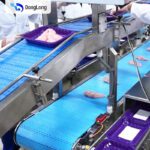
Plastic modular belts consist of interconnected plastic modules and are commonly used in food processing, packaging, product transfer, and industrial conveying systems.
Depending on the application, modular belts may feature flat-top, flat-grid, ribbed, or turning designs.
When selecting a plastic modular belt, buyers should consider:
- Belt pitch, width, and thickness
- Surface structure and opening design
- Plastic material and operating temperature
- Load requirements and conveying speed
- Sprocket specifications and drive configuration
- Requirements for curves, side guards, and accessories
For replacement projects, confirm the existing conveyor dimensions, connection structure, and sprocket compatibility rather than relying on appearance alone.
Conveyor Chains and Plastic Chain Plates
Conveyor chains and plastic chain plates are used in packaging lines, beverage conveying systems, product transfer equipment, and other industrial applications.
Different chain designs may have different pitches, widths, connection structures, and operating characteristics.
Selection should be based on the conveyor layout, product dimensions, load, operating speed, and working environment.
For replacement components, providing the existing model number, photographs, or dimensional drawings helps the supplier assess compatibility.
带式输送机
Belt conveyors are widely used for light- and medium-duty material handling, product transfer, packaging operations, and connections between production processes.
Key selection factors include conveyor length, belt width, conveying speed, product weight, surface friction, and installation space.
For integrated production lines, buyers should also confirm the positions of feeding, discharge, and transfer points.
滚筒输送机
Roller conveyors are commonly used to transport cartons, containers, and other goods suitable for roller-based conveying.
Depending on the project, the roller structure, conveying method, load capacity, and layout can be selected to meet warehousing, packaging, and production requirements.
Automated logistics projects may also require coordination with sorting equipment, lifting systems, and other conveyor sections.
Customized Conveyor Lines
When standard conveyor equipment cannot fully meet the site layout or production process requirements, a customized conveyor line may be considered.
Before developing a solution, buyers should identify:
- Material type, dimensions, and weight
- Required production throughput
- Conveyor route, curves, and elevation changes
- Available installation space and equipment interfaces
- Operating environment and maintenance requirements
- Required belts, chains, sprockets, and accessories
Providing complete technical information during the design stage helps improve communication and equipment compatibility.
3. Which Industries Use Donglong Conveyor Equipment?
Conveyor requirements vary by industry. Equipment selection should reflect the specific process, operating environment, and material handling needs.
Food and Beverage Processing
Food processing, beverage filling, and packaging lines may require conveyors to move ingredients, containers, or finished products between production stages.
Selection should account for the product type, cleaning procedures, operating temperature, and applicable food-contact requirements.
Logistics and Warehousing
Logistics systems use conveying equipment for package transfer, sorting, packaging connections, and warehouse operations.
The conveyor layout should reflect package dimensions, throughput, available space, and the required level of automation.
Packaging and Manufacturing
Packaging and manufacturing lines often connect processing, inspection, packaging, and other production stages.
Important considerations include conveying speed, product positioning, transfer methods, and interfaces with upstream and downstream equipment.
Other Industrial Applications
Depending on the operating conditions, conveying equipment may also be used in daily chemical products, pharmaceuticals, chemicals, and other industrial sectors.
Product and material suitability should be confirmed against the actual environment, product characteristics, and relevant technical requirements.
4. How to Select the Right Donglong Conveyor Equipment
A structured selection process helps buyers define their requirements more efficiently.
Step 1: Define the conveying application.
Identify the material type, dimensions, weight, and shape. Determine whether the system will handle bulk materials, individual products, cartons, or other items.
Step 2: Confirm the working environment.
Provide information about temperature, humidity, cleaning methods, and exposure to chemicals or other relevant substances.
Step 3: Check equipment specifications.
For belts, chains, and chain plates, confirm dimensions, pitch, width, drive configuration, and compatible sprockets.
Step 4: Plan the conveyor route.
Identify the conveying distance, curves, elevation changes, loading and discharge points, and available installation space.
Step 5: Discuss technical requirements with the supplier.
Drawings, site photographs, existing model numbers, and expected throughput can help the supplier evaluate equipment configuration and compatibility.
5. What Should Buyers Consider When Evaluating a Conveyor Supplier?
Industrial buyers should evaluate suppliers using more than the initial purchase price.
Important factors include product range, technical communication, specification matching, customization support, manufacturing information, quality inspection procedures, and after-sales services.
When evaluating Shandong Donglong Transmission Equipment Co., Ltd., buyers should review the product specifications, manufacturing capabilities, available components, and service scope relevant to their projects.
For projects requiring multiple conveyor products or accessories, preparing a detailed purchasing list and technical requirements can also make the sourcing process more efficient.
Specific product capabilities and service arrangements should be confirmed with the supplier according to the actual project requirements.
6. How to Contact Donglong
If you are looking for plastic modular belts, conveyor chains, belt conveyors, roller conveyors, or customized conveyor lines, preparing your technical requirements in advance can help make communication more efficient.
Consider providing:
- Product names or model numbers
- Equipment dimensions and key specifications
- Application industry and working environment
- Required quantities and project schedule
- Drawings, photographs, or site layouts
- Customization and accessory requirements
Visit the Donglong official website or the About Us page to learn more about the company and its products.
For specific product selection, equipment integration, or customized conveyor line requirements, contact Donglong through the official website to discuss your project and confirm the relevant technical details.
Shandong Donglong Transmission Equipment Co., Ltd. provides conveying products and solution options for industrial material handling and production line applications.




 English
 简体中文