Specialized Mesh Belt Conveyor for Automotive Industry
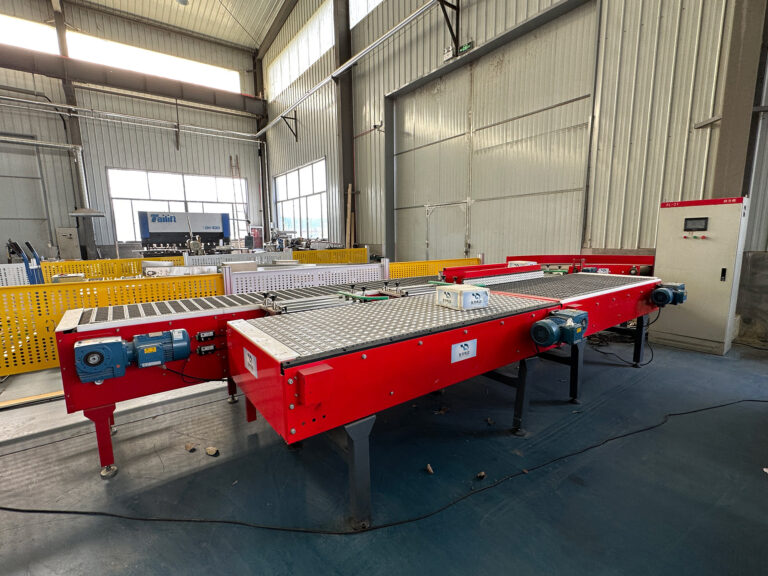
The specialized mesh belt conveyor (with side guards/partitions) for the automotive industry is a core ground conveying equipment for automotive parts and finished vehicles. Using modular plastic mesh belts as the conveying medium, paired with high-strength frames and drive systems, it enables continuous and stable transportation of automotive components (such as seats, tires, interior parts, engine assemblies, etc.), and can also be used for short-distance transfer of finished vehicles after production. It is a key automated equipment in automotive final assembly, component sub-assembly, and warehouse logistics.
Core Features
High Load Capacity and Stability: The mesh belt is made of high-strength engineering plastic or stainless steel. A single line can carry hundreds of kilograms to several tons of automotive parts, operating smoothly without deviation, making it suitable for heavy-load conveying scenarios in the automotive industry.
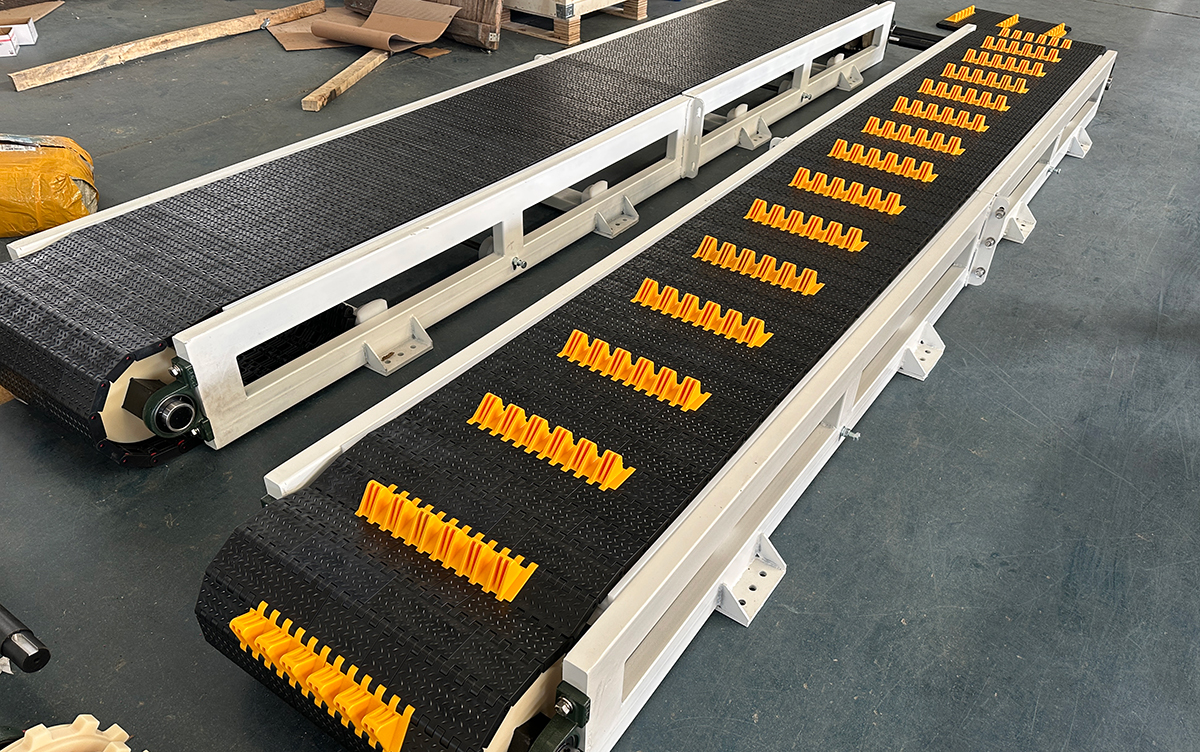
Precise Positioning and Anti-Deviation: The yellow side guards/partitions prevent material sliding, and together with the anti-slip texture of the mesh belt, they ensure the fixed position of components during transportation, meeting the precise docking requirements of automotive assembly stations.
Modularity and Ease of Maintenance: The mesh belt adopts a spliced structure, allowing quick replacement of damaged parts; the frame is made of standardized profiles, facilitating expansion and line modification to adapt to the flexible upgrading of automotive production lines.
Cleanliness and Weather Resistance: The gaps in the mesh belt are easy to clean, and it is oil-resistant and corrosion-resistant, meeting the hygiene and environmental requirements of automotive workshops, and can operate stably in multiple working conditions such as painting and final assembly.
Intelligent Adaptability: It can be equipped with variable frequency speed regulation, PLC control, and RFID identification systems to achieve adjustable beat rates and material traceability, seamlessly integrating with intelligent automotive manufacturing lines.
Typical Application Scenarios
Automotive Final Assembly Workshop: Used for conveying interior components (seats, instrument panels, doors, etc.) on sub-assembly lines, as well as for transporting chassis components (engines, rear axles) and body-in-white on mating assembly lines.
Component Manufacturing Workshop: Conveys small and medium-sized automotive parts such as tires, shock absorbers, and wiring harnesses, realizing automated flow from processing stations to warehouses.
Finished Vehicle Warehousing and Logistics: Completes the warehousing and outbound transfer of new vehicles after production, and realizes unmanned scheduling of finished vehicles in cooperation with AGVs.
Automotive After-Sales and Dismantling: Conveys components to be repaired or dismantled in automotive maintenance and scrap dismantling lines, improving operational efficiency and safety.